
TP-103 : The complete track for designing and building websites with .NET — Lite
- 120Training hours
- 40Lectures
- 10Assistant hours
- 2600Egyptian pounds
- 10Students maximum

Enrol on this programme now
and take the following offers and discounts, for a limited time
23%discount on morning sessions
2000 pounds instead of 2600
23%discount on afternoon sessions
2000 pounds instead of 2600
23%discount on evening sessions
2000 pounds instead of 2600
* These offers run for a limited period and may change or be withdrawn without notice. Note that the booking itself has to be made inside the academy.
** Morning slots run from 12:30 to 3:30 in the afternoon, afternoon slots from 4 to 7, and evening slots from 7:30 to 10:30 at night.
Start your journey now with the famous .net technology
A complete training track, from the very beginning to a professional level
Yes - learn everything you need in order to build professional web applications with Microsoft's .NET technology.
This training track includes all the material and all the hands-on practice needed to qualify you as a professional web designer and developer working with .NET technology.
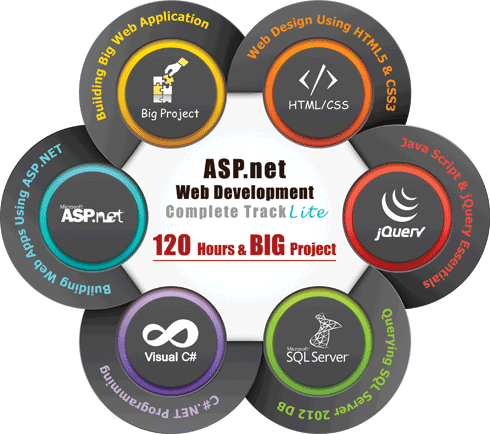
What does a complete training track mean?
A training track means a complete, consecutive set of courses, ordered and arranged so that it begins with you at the very first step of knowledge and carries you through to a professional level.
A complete training track means you need no prior knowledge at all in order to start learning, and that afterwards you will need no further courses in order to start working professionally!
Why a complete training track?
With so many techniques and technologies in use, so many syllabuses and levels, and so many terms and names in information technology, the biggest obstacle facing anyone who wants to enter the field is seeing the route clearly: where do I start, and where do I go next? That is the question most trainees ask. And because we have the experience to answer it, we built these tracks to put you on the right road, from the right starting point, in the right order.
Topic-103 OOP Theory
Watch this free video, recorded inside a Seven Dash training room. It is an introduction to the theory of object-oriented programming (OOP), which is taught as part of this training track.
For more free lectures, and the other parts of this series, visit our channel on YouTube

Only at Seven Dash
Register on this training track now and get these unique benefits along with the offer

Experience certificates Trainees receive two experience certificates from well-known software companies, stating that the trainee worked as a web developer at the company for 6 months, to use when applying for jobs elsewhere - awarded after passing the assessments taken during the course. This benefit is provided free to every trainee

Accredited certificates As well as the attendance and course-completion certificates from Seven Dash, you can obtain a certificate accredited by Cairo University and attested by the Ministry of Foreign Affairs, and one from Ain Shams University, should you want them*

Free hosting and domain Every trainee gets free hosting and a "domain" name, to put their sites online professionally

Discount coupons worth EGP 250 Every trainee gets free discount coupons worth EGP 250, to use themselves or to give to anyone else, to be set against the price of booking any of the Seven Dash training programmes
* An accredited certificate from Ain Shams University requires a payment of EGP 350 in administrative and examination fees (attestation not included), as well as sitting the exam in the labs of the university's Scientific Computing Centre.
An accredited certificate from Cairo University, attested by the Egyptian Ministry of Foreign Affairs, requires a payment of EGP 350 in administrative fees. Note that all the other certificates and benefits are provided free, at no additional cost.
The jobs open to those who take this training track
Once you have finished this track you can work as a professional web designer, or as a web developer using .NET technology (ASP.net), and you will be in a stronger position still once you have completed the practical projects the track includes. The experience certificates, which are based on real work done while you were studying the track, also let you add previous work experience to your CV.
Important notes on the offers and benefits
The offers, benefits and prices published here are available for a limited period and are subject to change without prior notice. Registering online through the form on this page, or by telephone, counts as an expression of interest only, and places no obligation on Seven Dash to provide the benefits, offers and prices fixed at the time of booking should they change later on.
Otherwise, the actual booking must be made at the company's premises with at least 10% of the course fee paid as a deposit, which secures the right to every benefit, offer and price fixed at the time of booking, even if they are changed later.
Contents of the training programme
Building web pages with HTML5 and CSS3
1 - XML, and structures for describing data.
Relevance to the main subject: a closely related introduction. Depth of coverage: moderate.
Main objectives:
To introduce the trainee to the fundamentals of programming logic by training them to use XML to build structures that describe different kinds of data, as well as introducing what a markup language is, and the rules for writing one, in an environment that is clearer and less fraught than HTML.
This topic covers the following:
- A simple introduction to programming languages and their different kinds.
- A detailed introduction to XML, its writing rules, its own terminology and its many uses.
- A range of examples showing ways of describing data with XML structures.
- Individual exercises using XML structures to describe various kinds of data from the world around us.
By the end of this section the trainee should be able to:
- Grasp fully what a markup language is and what it means, with a good enough understanding of the kinds of programming language and the differences between them.
- Think in a way that follows programming logic, to a reasonable degree.
- Know the rules for writing XML thoroughly.
2 - X-HTML, and building the structure of web pages.
(The main subject) Depth of coverage: deep.
Main objectives:
To bring the trainee to the fullest possible understanding of all the main tags in
X-HTML 4.0, and of how they are used to build the structure of web pages.
This topic covers the following:
- An introduction to HTML and X-HTML, the writing rules and the w3c standards.
- A full introduction to all the main tags in X-HTML 4/5, how they are used and worked with, and how they relate to one another.
- Exercises and practical examples combining different tags to build simple web page structures, with basic styling, images and navigation between pages, ...
- An introduction to using tables to lay out page content, and to building more complex structures.
- Using forms, frames and some advanced tags.
By the end of this section the trainee should be able to:
- A full understanding of the individual HTML tags, what each one is for and how each one is used.
- The ability to design complex structures with HTML.
- A working knowledge of laying a page out with tables.
3 - CSS 1, 2 and 3 for styling pages.
(The main subject) Depth of coverage: deep.
Main objectives:
For the trainee to understand how CSS is used to apply a page's styling in full, and to be able to style page content and position elements with modern CSS methods rather than with tables.
This topic covers the following:
- An introduction to CSS rules, what they are for, the writing rules and the selectors.
- A detailed, hands-on introduction to most of the properties used in CSS and their effect on elements.
- An explanation of the basic ideas behind combining different properties, how they relate to one another, and how to use that to apply more advanced styling of your own.
- An introduction to the different ways of laying out pages and positioning elements on the page with CSS.
- An introduction to the idea of "inheritance" in programming languages and how it applies in CSS.
- Practical exercises implementing advanced styling and tricks.
By the end of this section the trainee should be able to:
- A full grasp of the writing rules in CSS, and efficient use of selectors.
- The ability to apply complex styles to elements with CSS.
- The ability to style and position elements on the page with CSS techniques rather than tables.
- The ability to shorten code efficiently and apply the principles of inheritance with CSS rules.
4 - Workshop: building a simple website / CSS tricks.
What the workshop covers:
The workshop implements the design of a simple, multi-page website - five pages at most - using HTML for the structure of the page and CSS for the styling and the positioning of the elements.
Each trainee works individually on the same general design the group as a whole is using, with room for a few small changes.
* Designs prepared in Photoshop or anything like it are not used at this stage: a design is drawn on paper and implemented directly in code.
Main objectives:
To apply the ideas already studied in a practical setting, and to meet more of the advanced CSS methods and techniques in practice.
* The aim is not to produce a perfect website or a polished design; the aim is only to apply the code and the methods already studied in a complete practical setting, to see how they work together.
5 - The "artistic" standards of website design, and the idea of WEB 2.0
Relevance to the main subject: very closely related. Depth of coverage: introductory.
Main objectives:
For the trainee to learn the modern standards of website design, and to reach a reasonable level of artistic sense and creativity.
This topic covers the following:
- Using colour and type, ways of positioning elements on the page, and the geometric principles of design.
- A historical look at how design has developed, the idea of WEB 2.0 and modern design standards.
- The different kinds of website from an artistic point of view.
- Reviews and informed discussion of inventive, inspiring designs.
By the end of this section the trainee should be able to:
- Knowledge of the sound rules of good design, both geometric and artistic.
- Some inspiration, from following inventive work.
6 - Workshop: adapting ready-made templates and building more complex pages.
What the workshop covers:
The workshop falls into two main stages:
First: the lecturer prepares one of the professional pre-made templates as a PSD file, to use in creating a site for one of the suggested fields of work, and converts it into a complete, styled web file, making every change needed to suit the subject of the proposed site, with a detailed explanation as the work goes on, while the trainees follow the work and listen.
Second: once the trainees have followed the lecturer's work, a range of inventive ready-made templates is reviewed - differing slightly from one another in difficulty and complexity, and serving several different fields of work. Each trainee then proposes a field they are interested in, chooses one of the templates, and converts it into a complete website the same way.
Main objectives:
To meet one of the main goals of the course: a designer who can turn any pictured design into a website with HTML and CSS.
7 - Improving website performance
Relevance to the main subject: very closely related. Depth of coverage: moderate.
Main objectives:
To equip the trainee to design websites that perform better in speed and in complexity, work across different platforms, and suit the search engines.
This topic covers the following:
- Writing more effective, less complicated code.
- Reducing the weight of the page and of the assets it loads.
- Compatibility and the differences between browsers and platforms, and testing the page.
- Error pages, Meta tags and other parts of the site.
- An introduction to search engine optimisation (SEO) and the practices to follow while designing.
- Old and new techniques for the search engines (robots.txt, sitemap, micro formats,..)
- Mistaken ideas in website design.
By the end of this section the trainee should be able to:
- Better coding practice: more effective, less complicated code and lighter pages.
- The ability to design pages that are consistent and stable across different platforms.
- A good enough ability to talk to the search engines and design pages that suit them better
- Introduction To OOP Concepts
- Using Java Script and Language Principles
- Using jQuery
- jQuery Selectors
- Animation Effects using jQuery
- Overview of Relational Databases
- Getting Started with Databases and Transact-SQL in SQL Server 2008
- Overview of SQL Server 2008
- Overview of SQL Server Databases
- Overview and Syntax Elements of T-SQL
- Working with T-SQL Scripts
- Using T-SQL Querying Tools
- Querying and Filtering Data
- Using the SELECT Statement
- Filtering Data
- Working with NULL Values
- Formatting Result Sets
- Performance Considerations for Writing Queries
- Grouping and Summarizing Data
- Summarizing Data by Using Aggregate Functions
- Summarizing Grouped Data
- Ranking Grouped Data
- Creating Crosstab Queries
- Joining Data from Multiple Tables
- Querying Multiple Tables by Using Joins
- Applying Joins for Typical Reporting Needs
- Combining and Limiting Result Set
- Working with Subqueries
- Writing Basic Subqueries
- Writing Correlated Subqueries
- Comparing Subqueries with Joins and Temporary Tables
- Using Common Table Expressions
- Modifying Data in Tables
- Inserting Data into Tables
- Deleting Data from Tables
- Updating Data in Tables
- Overview of Transactions
- Using Programming Objects for Data Retrieval
- Overview of Views
- Overview of User-Defined Functions
- Overview of Stored Procedures
- Overview of Triggers
- Writing Distributed Queries
- Introduction to .NET
- Introduction to Visual Studio
- Debugging
- Intro to Variables / Data Types
- Variables / Data Types
- .NET Framework Classes
- Strings and Dates
- Branching
- Looping
- Object Oriented Programming Concepts
- Introduction to Classes
- Working with Classes
- Properties
- Methods
- Inheritance
- Organizing Classes
- Introduction to Arrays
- Handling Exceptions
- Creating and Throwing Exceptions
- Collections
- IO Classes
- Databases Operations using ADO.net
- Introduction to ASP.NET
- ASP.NET Controls
- Data Binding
- Retrieve Data
- DataSet / Providers
- ASP.NET Configuration
- Sql DataSource
- Other DataSource Controls
- Simple Validators
- Complex Validators
- Styles & Themes
- Master Pages
- Gridview
- State
- Cookies
Building a large dynamic website from scratch with .NET technology and MS SQL Server databases.
Prerequisites
There are no prerequisites for this training track, and you need no prior knowledge of programming languages or of computer science in order to start it
Job title
After finishing this training track you can work as a web designer and developer using .NET technology at any specialist software company, or work freelance building complete web applications
Meet the instructors on this course

Developer and trainer, .NET web and Windows applications
Ahmed graduated from the Faculty of Computers and Information with distinction and honours, placing third in his year in the faculty's computer science department, and went on to work as a developer of advanced applications with .NET technology for both the web and Windows. He currently teaches advanced courses at 7dash, with the aim of turning out trainees of a high standard both practically and academically, able to fit into the job market and to carry the pressures and challenges of working in the field.
A message for the trainer? Send it from here.
Trainer and web developer
Hamada works as a professional web developer across a number of platforms, PHP and MS ASP.NET among them, and holds Microsoft's certification as a Certified Solutions Developer for web applications, taken after his BSc in Computer Science. He has long practical experience building web applications aimed squarely at the job market, alongside delivering a good many training courses in the field.
A message for the trainer? Send it from here.
Trainer and web developer
Shaimaa began programming in 2002, writing statistical applications in C before moving on to Visual C#, and in 2006 she started building web applications on PHP and open-source software. She holds several Microsoft certifications, among them Microsoft Certified Trainer and Certified Solutions Developer for the web. She has long practical experience in building websites and web applications and in running development teams and software projects, and has held a number of positions at software companies, most recently eCoda Solutions, where she is currently the company's development team manager. Alongside all of that, and since 2004 in particular, she has written and delivered many specialist training courses in website design and development at a number of well-regarded academies and training centres.
A message for the trainer? Send it from here.
PHP web application developer
Marwa trains in web development with PHP and MySQL databases. She has more than three years of experience in the job market and in training, and holds certifications from Microsoft and CIW.
A message for the trainer? Send it from here.
Executive director, and database developer
Waleed started studying computer science and programming at around the age of 11, on the old Q-Basic, and has worked with a great many technologies across programming, databases and computer systems generally ever since. He is now executive director of the software company Code-Times, Ltd., specialising in systems analysis, MS SQL Server database development and building large applications with MS .NET technology for both the web and Windows. He currently runs the training departments at 7dash, as well as writing and delivering a number of specialist computer-science training programmes to a philosophy of his own: training content as close as it can be to real working practice at real software companies in the job market, rather than an academic syllabus with no regard for how the material is actually applied.
A message for the trainer? Send it from here.A message for the trainer? Send it from here.
What else comes with this course
-

Attend more than once, free of charge -
Drinks cafeteria -

A comfortable place to study -

Continuing support -

Private assistance hours
Reserve your seat on this course
Enter your details now and we will call you to fix a date and take you through the booking.
Have a question ?
We are glad to help you get a better grasp of things, so do not hesitate to contact us if you have any questions at all.